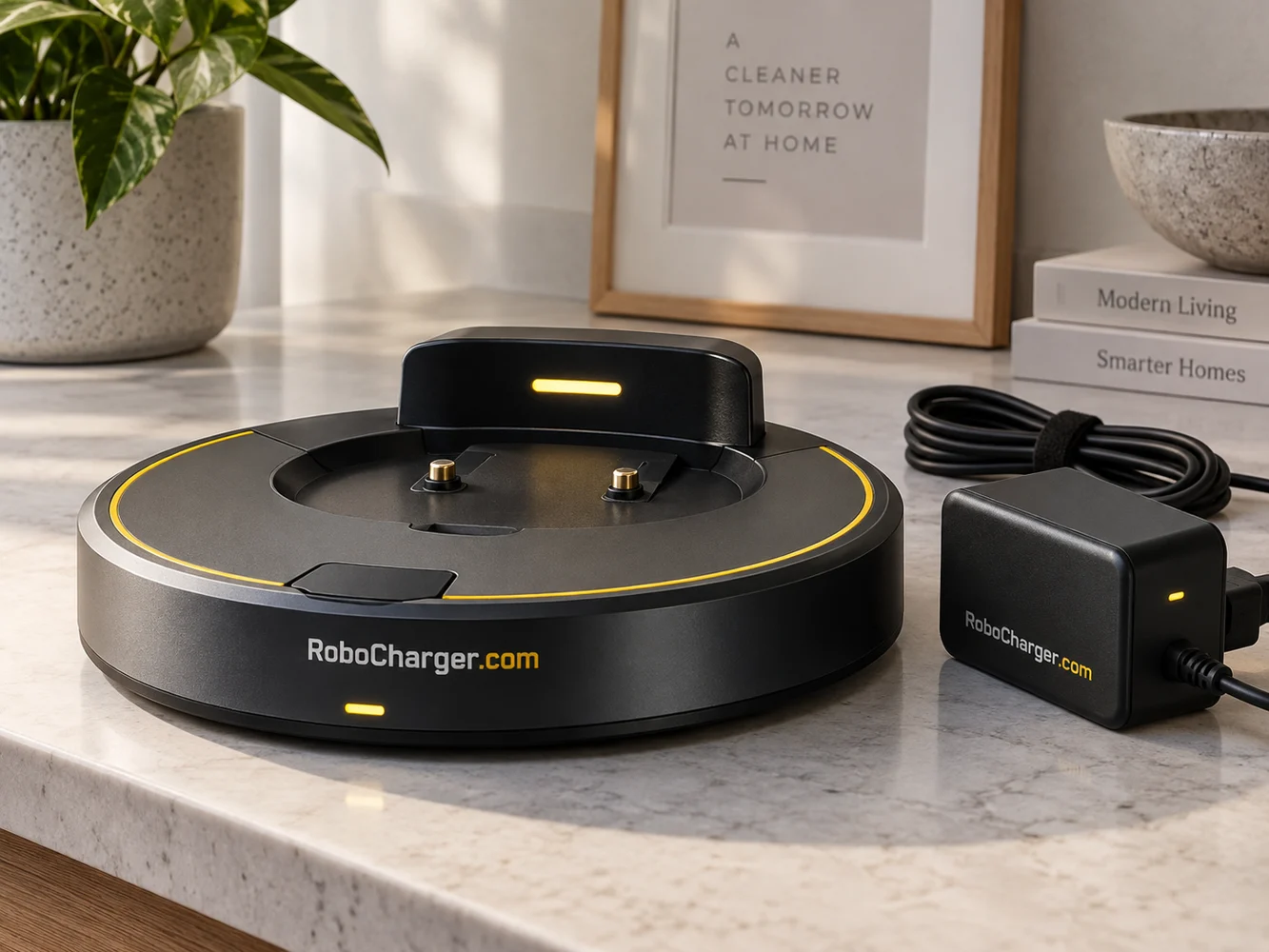
A customer looking for a replacement robot charger usually has a narrow question: will this work with the machine already at home? RoboCharger.com could support a consumer accessory brand built around answering that question clearly. The opportunity is in a useful catalog, accurate compatibility information, and an ordering experience that makes the correct product easier to identify.
The first buyer might own a robot vacuum with a missing charger, want a second charging location, or need to replace a damaged dock. Those are different needs even when the products sit in the same category. A spare power supply should not be presented as a complete docking station, and a charging base should not imply cleaning or emptying functions that it does not provide.
Choose one product family to serve well
This illustrative concept begins with a limited range for a defined set of indoor consumer robots. Starting with vacuums, lawn equipment, and pool robots at once would multiply the information needed to support each purchase. A narrow first range makes it possible to build a reliable model lookup and keep the support team close to the products being shipped.
The first catalog could separate complete docks, replacement power supplies, and cable or mounting accessories. Each listing would show what is included in the box. A customer looking at a styled product photograph should still be able to find an ordinary contents photograph and a readable part label before ordering.
Give bundles their own contents list. If a replacement dock requires a separately supplied power unit, state that beside the product selection. If an accessory only organizes an existing cable, describe that limited job directly. The commercial benefit comes from fewer ambiguous purchases, not from making every listing sound like a complete charging system.
Make model identification the first interaction
A useful site would ask customers to find the model identifier on their robot before choosing a charger. Provide a simple visual guide showing where that identifier may appear for the supported range. The guide should refer to the exact manufacturer documentation used by the product team, and distinguish a model name from a serial number.
Search results can then show supported products for the entered model. An unrecognized model should lead to a compatibility question rather than a guessed recommendation. Customers should be able to attach or describe the relevant label through the business’s support process once that process exists. The domain gives that help a memorable destination; the catalog does the actual matching work.
Keep manufacturer relationships clear. A compatible accessory and an original manufacturer part are different offers. Product descriptions and packaging should identify the seller and the basis of the compatibility statement. Permission to use another company’s marks and the wording of comparative claims need appropriate review before launch.
Treat the package as a second product page
The box should help someone verify the purchase after delivery. Show the accessory name, product identifier, supported models or a clear route to the current list, and the contents. A warehouse worker and a customer should be able to distinguish two similar configurations without opening both packages.
The FTC’s advertising guidance emphasizes truthful, evidence-based claims. For this concept, that means words such as compatible, original, automatic, and universal deserve careful attention. A broad word on the front of a box can create an expectation that a small note on the back does not resolve.
Photographs should also describe the actual offer. Show the sold accessory clearly, and label any demonstration robot that is not included. A neat desk scene can explain scale and placement, but the buying decision still needs an unambiguous view of the product and its connections.
Find customers at the moment of need
A plausible distribution path begins with model-specific product pages and repair-oriented retailers. Someone searching for a replacement already has a task to complete. Useful identification guidance can bring that person to the right listing and give a retail partner a dependable reference to share.
A small repair shop could become an early channel because it encounters questions about missing, worn, or damaged accessories. Give that shop a clear trade catalog and an escalation path for uncertain combinations. The relationship should be tested with a limited range before assuming broader retail demand.
Keep the search content closely tied to the product. A page explaining how to locate a supported model number is helpful. A generic article promising a charger for every robot creates a support burden unless the catalog can fulfill that promise. The content plan should grow with verified product coverage.
Design returns as a source of useful information
Consider a hypothetical customer who orders a power supply when the fault is actually elsewhere in the robot. The return process should ask enough to understand what happened without turning the customer into a technician. Record whether the issue was a mistaken model, unclear contents, delivery damage, or an unresolved equipment fault.
Those categories can reveal different fixes. A mistaken model suggests a lookup problem. Unclear contents suggest a listing problem. A repeated fault report may require product investigation. Treating all returns as a single number hides the information needed to improve the range.
The FTC’s substantiation statement also provides a useful reference for reviewing objective product claims before publication. Keep the evidence associated with each claim so a listing change can be reviewed against the supported product, rather than approved from memory.
RoboCharger.com could become a practical destination for this replacement and accessory task. Before inquiring about acquisition, compare the consumer support burden with the industrial dock concept. Bring the intended robot category, first product range, and likely sales channel. A focused retail proposal is a stronger starting point than a long list of unrelated accessories.