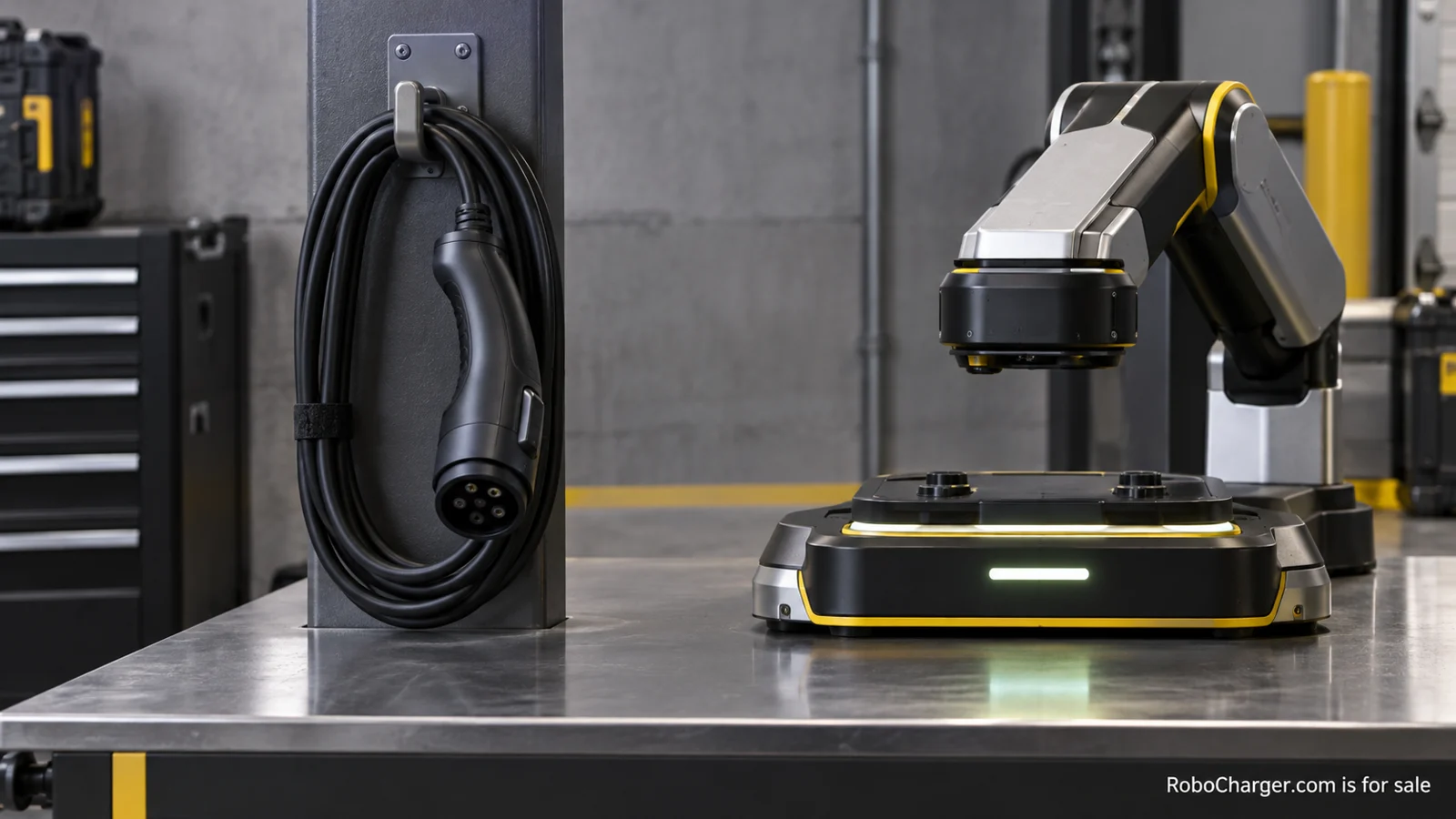
A robotic charger needs a better reason to exist than an impressive connection sequence. The useful question is whether automating that sequence solves a recurring operating problem at a particular site. A manual cable may already fit comfortably into the work. At another location, the connection may depend on a person making a separate trip, interrupting another task, or returning after a vehicle has been parked.
Start by observing that difference. Write down who connects the equipment, when it happens, and what follows if the connection is missed. The exercise is small enough to complete for one bay, yet it exposes assumptions that a product demonstration cannot answer. Include recovery in the decision. A fast connection means little if the operator cannot tell when it failed.
The examples below are illustrative planning tools. Site-specific engineering and safety decisions require the equipment suppliers and qualified site specialists. This comparison helps a project team decide what to investigate, not approve an installation.
Describe the manual baseline honestly
Watch a representative charging cycle before proposing a replacement. Record the arrival, parking, connection, confirmation, disconnection, and departure. Include waiting and walking where those are part of the routine. Do not count the entire parked period as work performed by a person. Likewise, do not omit a second visit just because it falls under another department’s schedule.
Ask the operator what usually goes wrong. The answer may be a blocked bay, a misplaced cable, a vehicle that returns late, or an unclear responsibility at shift change. Some of those problems might be solved by labeling, a changed assignment, or better scheduling. If the problem is primarily a missing ownership rule, installing a moving connector may leave the same uncertainty in place.
A good baseline distinguishes ordinary cycles from exceptions. Keep a record of both, with enough context to see why they differed. One unusually smooth demonstration of manual charging is no more representative than one unusually difficult day.
Compare three environments separately
An assigned depot bay has a different operating envelope from a public parking space. An indoor robot dock differs from both. Treating all three as the same automation problem produces a vague business case and an overloaded product specification.
| Setting | Question that favors further automation study | Question that may favor a manual routine |
|---|---|---|
| Assigned depot bay | Does connection require a separate staff visit after parking? | Is a trained person already at the port as part of the same task? |
| Public curbside space | Can the proposed equipment handle the actual parking and access conditions? | Would user assistance and varied vehicles dominate the routine? |
| Indoor mobile robot | Is charging already part of the robot’s planned return behavior? | Does the proposed change add complexity without removing a recurring interruption? |
Use the table as a discussion aid, not a score that automatically selects a product. A strong answer in one row does not cancel an unresolved requirement elsewhere. For example, the desire to avoid a separate visit does not establish that a robotic system can accommodate the vehicles at that site.
Find out what can be controlled
List the conditions the site can maintain. These might include assigned spaces, a supported vehicle family, a consistent approach, or restricted access during a connection attempt. Then list the conditions outside the team’s control. Public access, vehicle substitutions, and variable parking may belong in that second group.
Ask the supplier to describe its supported envelope using those same conditions. A demonstration in a different setting may be informative, but it should not quietly become evidence for the proposed installation. The project team should be able to point to each requirement and say how it will be checked.
The Alternative Fuels Data Center’s fleet guidance places infrastructure planning alongside vehicle deployment and driver training. That context is useful because the connection mechanism is only one part of making charging work for a fleet.
Follow the failed attempt
The recovery path often determines whether an automated routine is useful. Suppose a vehicle stops outside the supported position. Does the equipment wait, retry within a defined limit, request a parking correction, or call for an operator? Who receives that request? What happens if that person is covering another area?
Ask to see a controlled demonstration of an ordinary exception, with the supplier’s approved procedure. The goal is to understand the handoff. A system that clearly reports an unavailable connection gives the operator a different task from one that leaves the cause ambiguous.
Also consider the next departure. A missed charge discovered immediately is a different event from one discovered when the vehicle is needed. The decision record should say how an incomplete session becomes visible and who checks that record. This question applies to manual routines as well, which is why the baseline needs more than a count of plugging actions.
Keep charging management separate from connection
Physical automation and charging management can be purchased together or separately. A product may connect the vehicle while another system decides when energy should be delivered. Another product may schedule charging while retaining a manual connector. Describe these functions independently when comparing proposals.
The Open Charge Alliance’s protocol overview identifies OCPP as communication between charging stations and management systems. That helps locate one interface in the architecture; it does not answer the physical-fit question. Ask suppliers to identify the exact functions and integrations included in their offer.
This separation also improves cost comparisons. A proposal that includes management software and support should not be compared with a bare connector as though the scopes matched. Put installation, commissioning, maintenance, and software responsibilities into comparable categories before drawing conclusions.
Run a bounded evaluation
Choose one representative bay or operating pattern for the initial study. Define the supported equipment, the ordinary routine, and the exceptions to examine. Agree in advance on what evidence would justify continuing, changing the scope, or stopping. A useful evaluation can produce a decision to keep the manual method.
For a hypothetical depot, the first observation might show that staff already pass every vehicle during a required inspection. Connection adds little separate travel. A second area may receive vehicles after that inspection round, creating a recurring return visit. Those areas deserve different decisions even though they belong to the same fleet.
Keep the evaluation record readable. It should include the baseline, the proposed change, the conditions observed, and unresolved questions. Distinguish measured events from estimates. If a projected saving depends on a changed staffing pattern, state that dependency instead of treating the projection as an observed result.
Leave with a decision somebody can own
Finish the comparison with a short recommendation for the site being studied. It might be to retain the manual routine, improve its handoff, trial a specific automated connection, or gather missing evidence about compatibility. Name the person responsible for the next step and the information needed to complete it.
The best reason to automate is a repeatable problem that the proposed equipment can address within a workable operating arrangement. Start with one charging routine this week. Observe it, map its exceptions, and compare the supplier’s actual scope with that record. That produces a more useful answer than asking whether robotic charging is better in general.